A concert is prepared over weeks and set up in a few hours. The sound, the lights, the screens, the structure and the backline all have to be on site when the loading window opens, and none of it can be swapped for a replacement from the shop around the corner at the last minute. When something fails or arrives late, urgent transport is the only thing standing between a hiccup and a cancellation.
This guide explains how to plan the transport of equipment for concerts, festivals and fairs from Barcelona or Madrid to Málaga, Seville, Vigo and the rest of Spain: when an express van is enough, when an 8-metre box truck is needed, and how to work out timing, access and schedules.
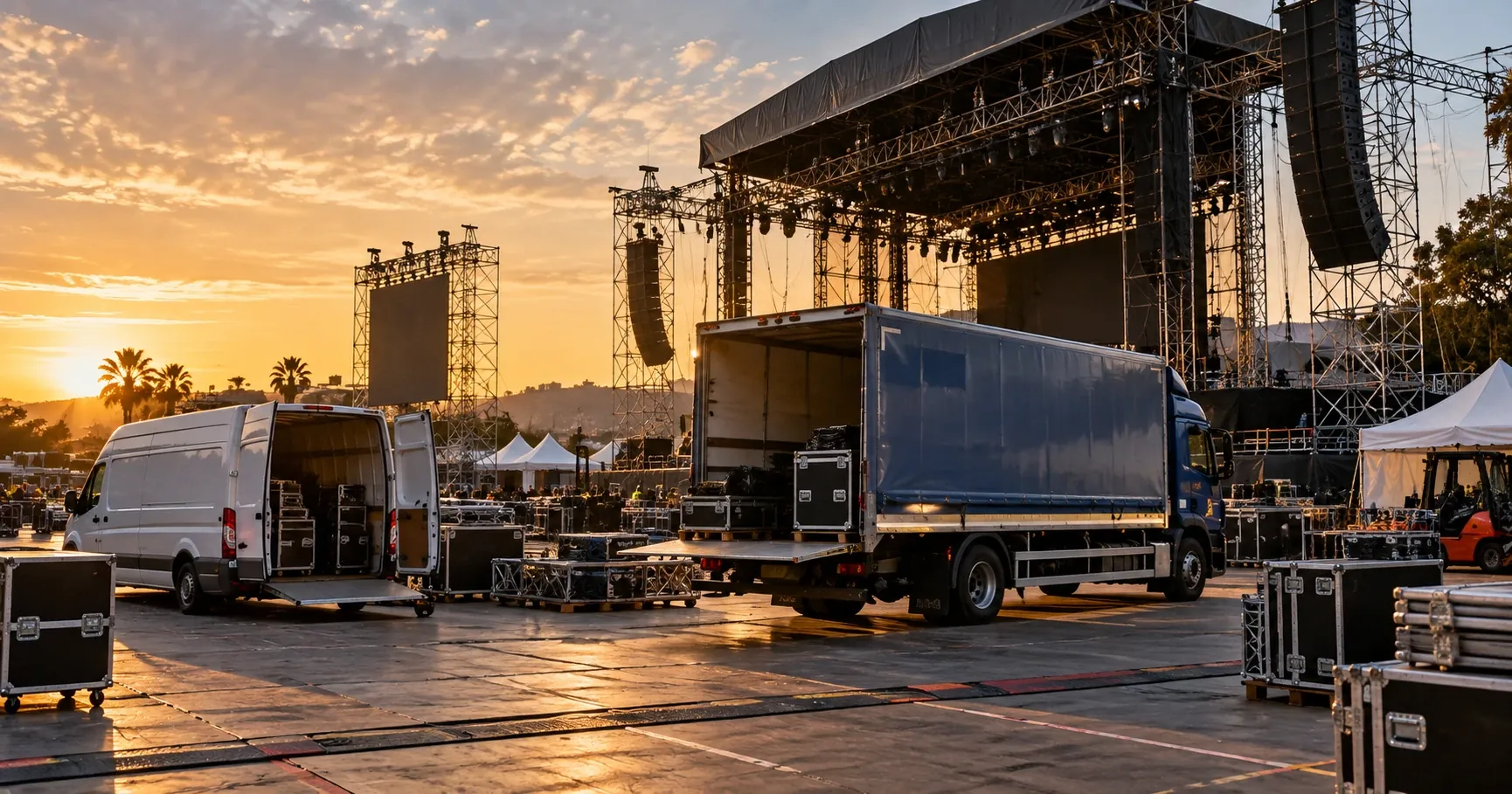
Why transport runs the show at a festival load-in
At a live event, almost everything depends on a sequence of hours: truck loading, structure build, sound checks, doors opening. Each stage leans on the one before it, so a delay in the arrival of equipment multiplies:
- Fixed loading windows. The venue assigns slots per vehicle; arrive outside yours and you can wait hours or lose your slot.
- One-of-a-kind gear. A specific line array, console or LED screen can't be swapped for just any other one at the last minute.
- No slack in the calendar. A festival can't push the stage back a day; the audience, the artists and the permits are already locked in.
- The cost of delay. Every hour the stage stands idle means technical crew, staff and artists waiting.
What equipment is moved for a concert or festival
- Sound systems: line arrays, subwoofers, monitors, amplification and racks.
- Lighting: moving heads, fixtures, dimmers and cabling.
- Structure: truss, towers, roofs and stage elements.
- LED screens and video equipment.
- Mixing consoles and control equipment.
- Backline: instruments, amplifiers and drums.
- Flight cases, cable boxes and auxiliary material.
- Backstage furniture, decoration and promotional material.
Much of this material is heavy, bulky and high-value, and it travels in flight cases on pallets. If the event is a trade fair or congress, see also our trade fair transport in Barcelona (Spanish-language page) and the guide on logistics for trade fairs and events (Spanish-language page).
Two solutions: express van or 8-metre box truck
Express van: the critical items, right now
When what's missing is one specific item — a replacement mixing desk, a batch of moving heads, a small backline, a screen, a spare part — the van leaves immediately and goes straight there. It's the fastest option: agile on the motorway, with no third-party loads, and with contact with the driver throughout the trip. It works well when the load fits within about 8 m³ and 1,000–1,200 kg (see the L4 van for urgent transport page, Spanish-language).
Rigid truck with an 8-metre box body: the main load
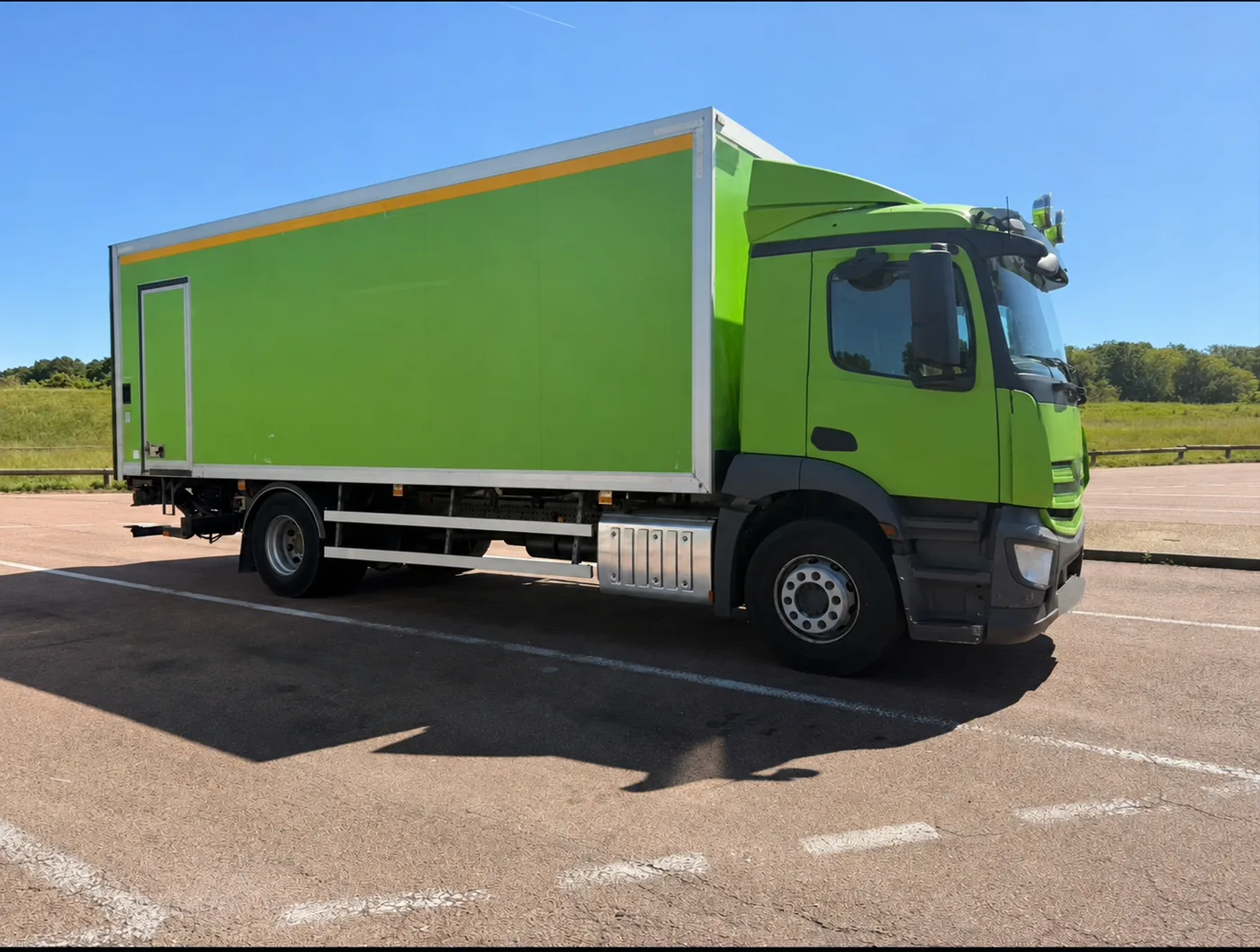
To move a complete small or medium stage in a single load, a rigid truck with a closed box body of around 8 metres is the usual tool: sound, lighting, truss and flight cases on pallets, all protected from rain and dust, with a tail lift for loading and unloading with no dock. The number of pallets depends on the height and shape of the load, which we confirm against real measurements. More details on the 12/18-tonne rigid truck page (Spanish-language).
| Need | Recommended vehicle | Why |
|---|---|---|
| A replacement part or critical item, small backline | Express van | Leaves immediately and goes straight there |
| Sound and lighting for a small stage, several pallets | 3,500 kg box body with tail lift | Closed body and tail-lift loading with no dock |
| Medium or large stage, the main load | Rigid truck with an 8 m box body | A single, direct, protected load |
| A large festival or several points of origin | Several coordinated vehicles | The load is split across synchronised departures |
Many productions combine both: the van leaves first with the critical items, and the truck carries the main load. If you're unsure, see the guide on which vehicle you need.
Distances and timing from Barcelona and Madrid
These are the indicative distances and driving times to the most common festival and trade-fair destinations in the south and north-west. They don't include loading, unloading or rest stops.
| Route | Approx. distance | Approx. driving |
|---|---|---|
| Barcelona → Madrid | 620 km | about 6 h |
| Barcelona → Seville | 1,000 km | about 9 h 30 |
| Barcelona → Málaga | 1,000 km | about 9 h 30 |
| Barcelona → Vigo | 1,150 km | about 11 h |
| Madrid → Seville | 530 km | about 5 h |
| Madrid → Málaga | 530 km | about 5 h |
| Madrid → Vigo | 600 km | about 6 h |
These are indicative figures and can vary with the route, traffic and roadworks. We collect and deliver anywhere on the Spanish mainland; for other corridors, see our routes between cities (Spanish-language page).
How timelines are actually met
- Up to about 600 km (Madrid, Valencia, Zaragoza, Bilbao), the usual pattern is to collect in the morning and deliver the same day.
- 1,000 km trips (Seville, Málaga) call for a relief driver or a planned rest; this is flagged before confirming.
- Van: more agile on the motorway; on long distances, rests or a relief driver are also planned to arrive safely on time.
- Early departure: an hour's buffer against the loading window avoids losing it to traffic, roadworks or a queue at the access gate.
- Night and weekend work: load-ins are usually overnight; we handle urgent jobs 24 hours a day, subject to vehicle availability.
That's why advance notice matters: a well-planned hour is worth more than two hours of improvisation. For the general logic of a dedicated service, see direct transport without chargement partagé for delicate goods.
How to plan delivery at a festival venue
- Loading window: confirm with production the exact time each vehicle can enter.
- Vehicle access: ask for the specific gate (not the festival's public address) and a GPS reference.
- Access limits: height, width, turning space and ground conditions; a dirt or gravel site affects which truck can be used.
- Accreditation: number plate and driver details for the vehicle pass, if the venue requires one.
- Contact: a phone number for someone from production or venue logistics available during unloading.
- Equipment at destination: staff, a forklift or a pallet truck; the vehicle's own tail lift solves unloading with no dock.
- Loading order: what's needed first gets loaded last, so it comes off first.
- Return leg: if there's a breakdown and the material needs to come back, it's planned from the start.
How to prepare the equipment for the trip
- Flight cases closed, with wheels locked and labelled with the event name and contents.
- Pallets with film, corner protectors and strapping; nothing overhanging.
- An inventory (packing list) with the number of items and photos before loading.
- Fragile, orientation and non-stackable marks on sensitive equipment.
- Straps and anti-slip matting in the vehicle; heavy items at the bottom, with no gaps where the load could shift.
- Real weight and dimensions for each item, to choose the vehicle and avoid access problems.
Price, the value of the equipment, and documentation
The price depends on the kilometres, the vehicle, the urgency, the time of day (night and weekend), expected waiting and tolls. We confirm a fixed price before departure and flag any extraordinary items in advance. For a first idea, you can use our price calculator.
Concert equipment is often high-value. The carrier's legal liability for loss or damage is limited per kilo of goods, so it's worth declaring the value and considering additional goods-in-transit insurance. On delivery, check the items before signing and note any damage as a written reservation on the delivery document. More details in the guide on direct transport.
Information we need for an urgent quote
- Origin and destination with address, GPS reference and contact person.
- Date and loading/delivery window at the venue.
- List of equipment, number of pallets or flight cases, dimensions and weight.
- Whether unloading needs a tail lift or there's a dock.
- Whether a return trip after the event is needed.
- Approximate value of the equipment if you want to declare it or insure it.
Frequently asked questions about concert and festival transport
How long does it take to get from Barcelona to Seville or Málaga by truck?
It's about 1,000 km and roughly 9 h 30 of driving. In a truck over 3.5 t, a single driver can't exceed 9 hours of driving a day, so a second driver is needed to arrive the same day; otherwise, an overnight stop is planned. In a van, with a relief driver or a planned rest, the timeline is shorter.
Can you carry just one urgent piece, like a mixing desk or a spare part?
Yes. For one critical item or a small batch, the express van leaves immediately, as a direct service with no other customers' loads. It's the fastest way to solve a last-minute problem.
What fits in an 8-metre box truck?
A complete small or medium stage: sound, lighting, truss, flight cases and backline on pallets, in a single load. With a tail lift it's loaded and unloaded with no dock needed. The exact number of pallets depends on the height and shape of the load.
Do you work nights and weekends?
Yes. Concert and festival load-ins are usually overnight or at weekends, and we handle urgent jobs 24 hours a day, subject to vehicle availability.
Can you deliver directly to the festival site?
Yes, as long as we're given the vehicle access gate, the loading window and a production contact. We confirm before departure that the vehicle can access the site by height, width and ground conditions.
Do you handle the return of the equipment after the event?
Yes, with a scheduled return service after breakdown, either to the original origin or to another destination.
Urgent equipment for a concert or festival?
Send us the origin, destination, loading window, dimensions, weight and a list of the equipment. We'll recommend an express van or a truck and give you a fixed price.
Request urgent transport →